
Blaine City Directory Holdings
Blaine's best documented historical shelf is not a verified Polk run. The Minnesota Historical Society telephone-directory finding aid calls its larger collection an Anoka County inventory and lists Blaine entries within it. Those Blaine entries begin in 1957 and continue through 2011. They include print copies, yellow-page variants, and microfiche. For Blaine family research, the evidence supports a city-directory trail, but it does not support claiming that every Blaine year came from one publisher or that every Blaine volume has a reverse section.
| Collection found | Years represented | Holding location | Access route |
|---|---|---|---|
| Blaine telephone directories | 1957-2011, with a displayed 1993 gap | MNHS shelves and microfiche | Open research; verify the exact edition |
| Blaine print, fiche, and yellow variants | 1957-1992 print; 1994-1996 fiche; later mixed formats | MNHS finding-aid locations | Use the shelf or fiche reference for the chosen Blaine year |
| Regional Anoka-Blaine-Coon Rapids directory | 1976 | FamilySearch off-site storage/scanning | Blaine catalog lead; image availability is unconfirmed |
| Blaine local papers, maps, and obituary indexes | Varies by series | Anoka County Historical Society | Blaine reading-room or research-request route |
The Blaine finding-aid sequence lists a visible break at 1993, then fiche in 1994 through 1996. It also shows Blaine print or fiche combinations into 2009, yellow-page material in 2010, and print plus yellow-page entries in 2011. That is a Blaine holdings sequence, not proof of continuous publication, a complete subscription list, or a final Blaine directory year.
The MNHS finding aid is the source behind this Blaine city directory shelf image.
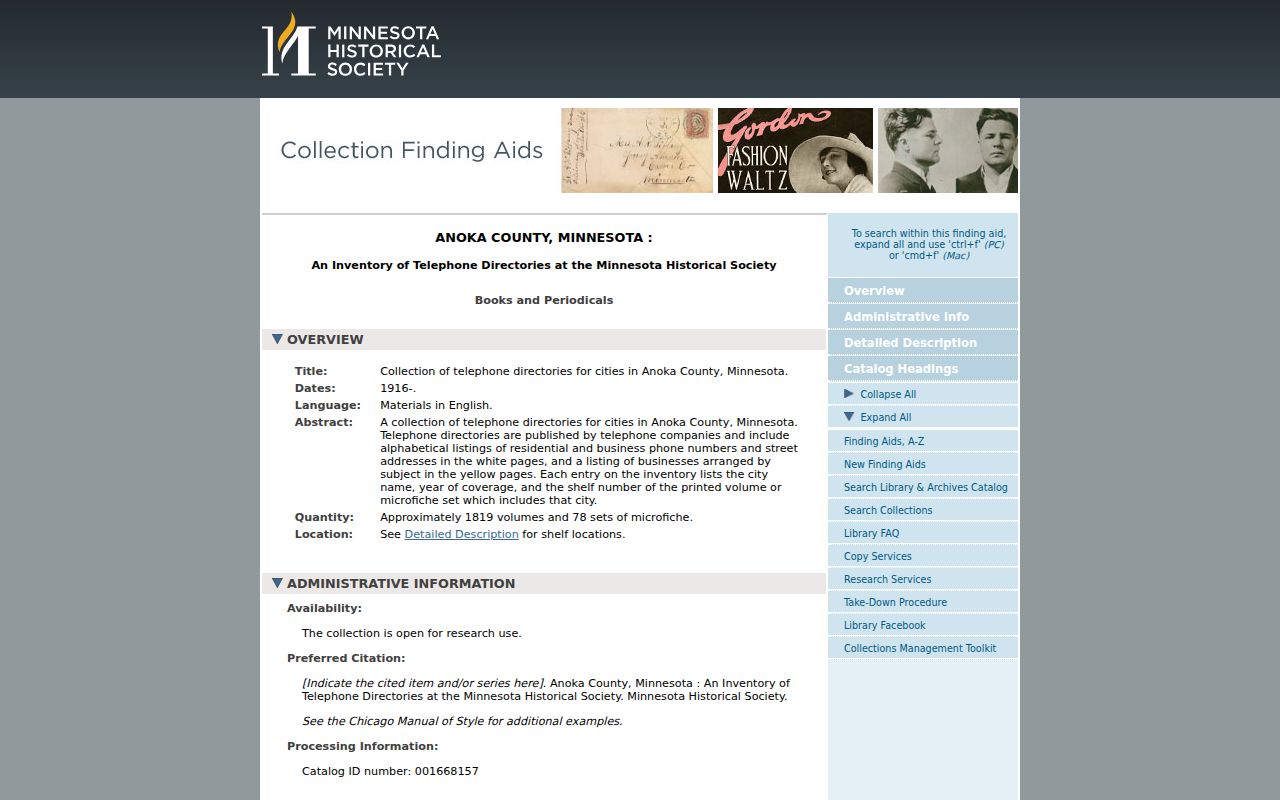
Its shelf-by-year format is why a researcher should record the year, format, and item location before drawing a conclusion from a listing.
Blaine Telephone Directory at MNHS
MNHS offers more than a generic search box for Blaine work. The finding aid supplies precise shelf references for many Blaine entries, including several print or yellow alternatives in the same year. A Blaine physical visit can settle questions that the web list cannot, such as whether a particular volume includes a reverse section, whether a title page identifies a telephone company, and whether an alternate copy fills a worn or missing page. The wider Anoka County collection is described as roughly 1,819 volumes and 78 microfiche, beginning in 1916, but the Blaine segment must be selected city by city.
Begin a Blaine surname search with a year, then consult the front matter before copying an entry. The abbreviation key and the volume title explain that Blaine edition's conventions. A Blaine listing can be a subscriber record or a business listing. It is a dated observation, not a statement of legal title or a complete account of a household.
Blaine Directory Catalog Lead
A second, narrower Blaine lead is the FamilySearch catalog record for Anoka - Blaine, Coon Rapids (Anoka County, Minnesota) city directory: 1976. The catalog gives the 1976 publication year and call number 977.665 E4p 1976. It also identifies FamilySearch Library off-site storage/scanning and carries a restriction notice. That makes it a valuable Blaine request lead for a regional search, not a promise that a public scan can be opened from home.
Search the regional title as written when a Blaine-only search fails. Nearby communities may share the Blaine volume, while a modern Blaine municipal label may not be the indexing term used at publication. Account access, a FamilySearch center, or a scan request may be necessary. No readable Blaine entry image was available during the research pass, so no named household, phone number, or occupation is treated as a published example.
The FamilySearch catalog entry is shown in this Blaine city directory image.
The image documents the catalog route and restriction context, which is different from a digitized directory page.
Note: A catalog record identifies a discoverable item, while access depends on current restrictions, storage status, and any available scanning route.
Reading Blaine Directory Entries
Inspect the actual Blaine edition before treating an abbreviation or field as certain. A Blaine telephone or city entry can include a surname, given name or initials, spouse or household notation, business or occupation, telephone number, street address, and a classified-business section. Owner, renter, and widow markers may appear in some types of directories, but the Blaine holdings research does not establish that they occur in every Blaine volume. Copy the Blaine page number and the edition year with every transcription.
| Printed name | Record initials, spelling variants, suffixes, and any household notation exactly as shown. |
|---|---|
| Address | Capture the street number and name, then compare it with the dated edition rather than a current map alone. |
| Telephone or listing type | Note the listed number or business/classified context only if the entry prints it. |
| Business or occupation | Copy only what appears in the edition. Do not infer a person's work or current role from a historical listing. |
| Edition details | Keep the Blaine directory year, page, shelf or fiche reference, and the abbreviation key. |
- Criss-cross directory
- An address-ordered section that can lead from a street address to a listed subscriber, but only when that edition actually contains one.
- Householder index
- An index arranged around a household or primary listing rather than a complete census of everyone at an address.
- Abbreviation key
- The volume's front-matter explanation of its marks and short forms; photograph or transcribe it before interpreting an unfamiliar entry.
Note: A directory presence supports a dated listing, while an absent name may reflect an unlisted number, a move, or a different spelling.
Blaine Directory by Address
A Blaine reverse or criss-cross section reverses the ordinary direction of a directory search. Instead of a surname leading to an address, a Blaine address can lead to the listed subscriber or business. This is especially useful when a Blaine family-history question begins with a house rather than a person. It still has a narrow scope: only editions with a reverse section can provide that route, and the returned name is a listing clue, not a full occupant roster.
For a current Blaine parcel, use a recorded legal description and the county property system rather than trying to make a historical telephone book prove ownership. The Blaine street directory addresses the modern, address-keyed county and city records. Retain the Blaine historical edition, page, and any reverse-listing result with the date that gives it meaning.
Green Chambers and Blaine Records
Blaine's official history names Green Chambers as a first permanent Blaine settler in 1865, after the Civil War. The same Blaine history notes that the area was considered part of Anoka until 1877, when Blaine organized as a township. Those Blaine facts create a useful archival search path, not a claim that a telephone book will contain an early settler. Test the name and the 1865 to 1877 window in Blaine and county newspapers, census material, maps, church or civil indexes, and land records.
Blaine historical locality labels matter. Later Circle Pines and Lexington boundary changes can place a Blaine household under a different locality than a modern Blaine address. Blaine ownership plats from 1888, 1914, and 1932, along with maps reaching back to the 1850s, help bridge the place name when a street number does not. The Anoka County Historical Society keeps those Blaine materials distinct from a directory listing.
Note: An early household can be cataloged under Anoka or Blaine Township, so place names should be tested beside the record date.
Blaine Newspaper Directory Companions
The Anoka County Historical Society research collection supplies the best Blaine companion shelf for a directory lead. It lists Blaine newspapers, obituary and vital-announcement indexes, cemetery and burial information, photographs, personal papers, maps, and plat books. Its microfilm includes the Anoka County Union from 1865 through 2002 and the Anoka Herald from 1885 through 1960. The Blaine Banner appears in the collection list, but its exact Blaine run was not located in the published text.
A Blaine obituary index or newspaper notice can supply a date, relative, or locality that helps choose between people with the same name. Staff generally need an exact death date before searching Blaine-area microfilm obituaries. The Society's research request begins with about 15 minutes free, then is listed at $20 per hour, with photocopies at 25 cents per page plus postage. Restricted items and missing online material are normal limits of this Blaine collection.
The Historical Society research resources appear in this Blaine city directory companion image.
Its newspapers, maps, and indexes provide dated context that can confirm or question a single directory entry.
Trace Blaine City Directories
Use adjacent Blaine editions to turn one entry into a household timeline. A Blaine three-year or annual chain can show a changed street, altered initial, new household notation, or a disappearance that needs another source. Pair the Blaine directory date with the closest available census, deed, permit, obituary, or marriage clue. The 1905 Minnesota census is one useful comparison point because its collection can include names and street or rural-route addresses, but it remains a dated census snapshot.
- Choose the Blaine directory year nearest a known move, death, marriage, or address.
- Record the Blaine name exactly, along with the street, listing details, page, and edition reference.
- Check the preceding and following editions for spelling changes, initials, household clues, and a new address.
- Inspect a reverse section only after confirming that the selected volume includes one.
- Compare the dated chain with census, deed, obituary, permit, or vital-index evidence that answers a different question.
A Blaine person who disappears may have moved, died, changed a listing, or become unlisted. The Blaine change becomes persuasive only when a second dated record agrees. A modern Blaine match should be checked through official current records, including the Blaine resident lookup, instead of assuming the old subscriber is the same person today.
Blaine Directory Reading Rooms
Online results are only part of the Blaine route. MNHS research services can handle Blaine directory, telephone-book, court, and marriage research requests, while in-house Gale Family Library tools include licensed resources such as MN People, FamilySearch, and fire-insurance maps. The Anoka County Historical Society's Collective Access collection is still being added to and some files are restricted, so an empty Blaine online search does not establish that no source survives.
The Blaine-area History Center has published an appointment and relocation caution, with displayed regular hours of Tuesday 1 to 7 and Wednesday through Friday 10 to 4 before any current service change. Its county page also reported Anoka County Library branch services ending August 28, 2026. Confirm current Blaine research access before travel. The Anoka County History Center and Library is at 2135 3rd Ave N in Anoka, and the listed phone is 763-421-0600.
| 1957 | First Blaine holding shown in the MNHS finding aid, not a verified first local directory. |
|---|---|
| 1976 | FamilySearch catalogs a regional Anoka-Blaine-Coon Rapids volume. |
| 1993 | The MNHS Blaine holdings sequence displays a gap that requires shelf verification. |
| 1994-1996 | Blaine entries are listed as microfiche in the finding aid. |
| 2010-2011 | Yellow-page material is listed for 2010; 2011 has print and yellow-page entries. |
Note: The holdings list documents availability, not every issue's contents, so confirm the exact shelf item before treating a gap as final.